Saturday, July 6, 2013

Hadamar and Bergen-Belsen

July 4, Hadamar

We started the day with a 1.5 hour drive to Hadamar.  The scenery along the way was beautiful, lush green rolling hills.  It reminds me of the setting for the Sound of Music.

We arrived at Hadamar at the same time as a High School tour of the facility.  I was impressed that this site was a field trip for schools (during their last week of school, none the less…and we thought our schools ran late into summerJ). 

Hadamar was a psychiatric clinic where 15,000 men, women and children were killed between 1941 and 1945 in what is known as the Nazi euthanasia program, or the “T4” program.
These were killed by the resident physicians and staff – not by the Nazis themselves.   The victims were German patients with disabilities, mentally disoriented elderly persons and psychologically and physically disabled men women and children.   Although these acts were initially were carried out somewhat  humanely with lethal injection, they eventually degraded to the gas chambers and firing squad executions.    


July 5, Celle, Bergen Belsen
I am still processing my visit to Bergen Belsen concentration camp.  I need time to review my notes and collect my feelings on what we saw and experienced there.


Berlin - Olympic Stadium, Wannsee Villa, Track 17 and Memorial to the Murdered Jews of Europe

July 6, Berlin - Olympic Stadium, Wanssee Villa, Track 17 and Memorial to the Murdered Jews of Europe

Anther busy day. We started the day by visiting the Olympic Stadium in Berlin.  Although the Olympic Stadium is not a formal holocaust location, it was interesting to see and learn more about the use of this stadium to spread Nazi propaganda.


The 11th Olympic Summer games officially began on August 1, 1936.  3,956 athletes took part in the competitions.  Germany won, followed by the USA and Hungary. 
During the games, the German capital did it’s best to presented itself in in the most attractive and sophisticated manner.  The German SA were ordered to stop all attacks between June 30 and September 1, 1936.  The goal was for all of the spectators to see Germany in a positive light. 
After the Olympic Stadium we visited Wannsee Villa.  I have studied the Wannsee conference for years, but nothing prepared me for what I found.  The Wannsee Villa is located in Wannsee suburb of Berlin.  On January 20, 1942, 15 high-ranking Nazi Party and German government officials gathered at the villa to discuss and coordinate the logistics of the “Final solution” for the Jewish people.
The “Final Solution” was the military code name for the systematic, deliberate, physical annihilation of the European Jews. 
The Villa was located in the most picturesque location that I have ever seen.   The villa is located on a lake, with sail boats in the distance.  It  was a destination for SS Officers who needed to recuperate.  In attendance were all the infamous SS staff and others to include, General Reinhardt Heydrich,  Major General Heinrich Muller,  Lieutenant Colonel Adolf Eichmann,  Colonel Eberhard Schonegarth, S Major Rudolf Lange, Major Rudolf Lange, Major General Otto Hofmann,  State Secretary Roland Freiseler, Ministerial Director Wilhelm Kritzinger, State Secretary Alfred Meyer, Ministerial Director Georg Leifbradt, Undersecretary of State Martin Luther, State Secretary Wilhelm stuckard, State Secretary Erich Naumann, State Secretary Josef Buhler and Ministerial Director Gerhard Klopfer. 
I am naming these individuals on purpose.  Much of the history of Nazi Germany is a reminder that no one acts alone.  Hitler required many equally unbalanced individuals to accomplish his objectives.  They were all here at one time.
The Wannsee Conference was convened for two purposes:
·         Decide how to deal with mixed descent as defined by the Nurenberg laws
·         To secure support from government ministries and other agencies relevant to the final solution
General Heydrich indicated that approximately 11,000,000 Jews in Europe would fall under the provisions of the final solution.  At the time, 2 million Jews had already been murdered throughout Europe. 
All of the attendants of the meeting were given copies of the minute meetings and directed to destroy them, however one did not.  As a result,  we have a detailed record of the decisions that were made there.  Copies of all of the letters, as well as an incredible exhibit all exist in the building where the conference was held.  These documents were used extensively during the Eichmann trial in 1962.
I found it very difficult to leave this location.  The exhibits were so detailed, so descriptive and so compelling.   I purchased the book that has a description of the exhibit because I did not feel that I had time to view it all.  If you find yourself on a similar tour or simply in this region of Germany,  your visit will not be complete without a visit to the Wansee Villa. 
Following the Wansee Villa we stopped at Track 17 Memorial at Grunewald Railway Station. 
Deutsche Bahn AG (the German railway system) erected a central memorial to commemorate the deportation of Jewish citizens during the Nazi era.  The deportation of the European Jews to the extermination camps would not have been possible without the extensive collaboration of Deutsche Reinchsbahn. 
The memorial is extremely powerful.  The location of the memorial (far away from the public areas) is a reminder that the deportation of German Jews was something that was done away from the public eye.  The memorial is comprised of 186 cast steel rows arranged in chronological order and set in the ballast next to the platform edge.  On each row is a date or transport, number of individuals transported, the destination and point of departure.  The striking part is that vegetation has been allowed to grow in between the rails.  This is to symbolize that no more trains will ever depart from this platform. 
From there we arrived at the Memorial to the Murdered Jews of Europe in Berlin.   There was tremendous controversy surrounding the development of a memorial as well as picking the memorial.  I was torn the entire time I was there as to how appropriate and effective it was.  It is certainly striking.  I can say that the museum that is located directly beneath the memorial was stunning and like nothing else I had seen to date.  In addition to the beginning, that offered a detailed description of events leading up to 1945,  the exhibit chose to focus on a small number of personal experiences and personal diaries to educate.  I was deeply  moved as I walked through the exhibit and pictures the individuals being described.  Any one of the stories could have been about my family, or someone that I knew.  In particular, the use of personal diaries was heart wrenching and left me feeling broken.  I feel that the memorial achieved much of what it intended to.  This is discussion that I will go into in more detail…at a different time.

Tomorrow we visit Ravens Bruch and Sachsenhausen.  Although we have only been traveling together for one week, our group has become extremely close – I imagine crying together can do that.  The time that we have during meals and on the busses and trains offers the opportunity for connection.  I am continuously amazed at how much knowledge and experience our group has and how much I am learning from them.  I am extremely honored to be part of this journey.  Liyla Tov and gute Nacht.

 Memorial to the Murdered Jews of Europe


Wednesday, July 3, 2013

Pictures from Frankfurt Germany

I am taking advantage of having internet access to upload some pictures that go with my post last night.  Happy 4th of July!

 Opera House in Frankfurt
 Model of Ghetto, Frankfurt Jewish Museum
 House where Anne Frank grew up, lived.  Frankfurt
 Memorial to the Jews of Frankfurt Germany
 Memorial to the Jews of Frankfurt Germany
 Memorial to the Jews of Frankfurt Germany

 Frankfurt Synagoge burning during Kristallnacht
 Memorial Wall with names of all of the Frankfurt residents who were murdered

Jewish life, on display at the Frankfurt Jewish Museum

Frankfurt, Germany

We made it to Germany!  First, a disclaimer.  I am wiring this blog at 11 a.m. Charlotte time, 5 p.m. Germany time after being up for over 30 hours.  Please keep this in mind J
We left Dulles at 3 p.m. yesterday, the group was excited to begin the Eurporean portion of our journey.  After a one hour bus ride, three hour wait, seven hour flight, and a one half hour bus ride we arrived at our hotel in Frankfurt Germany.  We landed in 60 degree weather which was exactly how I envisioned the weather in Germany, cool and overcast.
We arrived at 5 a.m. local time, and after discovering that our rooms would not be ready until later in the day we set out for some adventure. First on the list was exploring Jewish Frankfurt, or I should say-what is left of Jewish Frankfurt.  We drove by the house where Anne Frank was born and spent the first few years of her life. Prior to going into hiding the Frank family has called Frankfurt home and their heritage goes all the way back to the 15th Century.
We stopped at the Holocaust Memorial for the Jews of Frankfurt.  The memorial consist of three distinct sections, trees with five branches (Star of David), stones on the ground (to remind us of the unsteady footing that the Jews experienced thorough the history of life in Frankfurt) and a stark white wall lined with small metal blocks with engraved biographical information of the more than 11,000 Frankfurt Jews who died during the holocaust.  Each name has several stones placed on top of it, as required by the Jewish ritual of mourning.  
The memorial was moving, and shocking to see a representation of the lives that were, could have been, but were no longer.
The most difficult part for me was the outline of a synagogue that was burned during kristalnacht.  I was standing on the outline of where the temple was located, a huge temple that held over 12,000 people.  Tomorrow I will post pictures of the Synagoge burning on that night as well as the outline of what remains today (hoping that my internet connection cooperates).  Just standing there caused me to shiver .  The location is where the Frankfurt Jewish Museum is located and is surrounded by a medieval cemetery. 
I knew some things about Frankfurt, but I was overwhelmed to have all of the demographic and historical detail presented in such clarity.  Jews have lived in Frankfurt for over 900 years.  The Jewish community can be traced back to the 12th century.  Jews were integral in every aspect of life here.  In the 19th Century Frankfurt played an important role for the Reform and Neo-Orthodox movements.  In 1933 Frankfurt’s Jewish population numbered 26,158, by 1945 only 160 people remained!  Over 12,000 were deported, many were able to flee and many elderly committed suicide upon learning their fate.   Currently Frankfurt has one of the four largest Jewish communities in Germany, with over 7,000 Jewish residents.
We visited the Jewish Museum of Frankfurt.  I felt like the artifacts on display were the equivalent of visiting ancient artifacts like the dinosaur remains at the Smithsonian.  They are from a world long ago, and represent a life that is now distinctly different from ours.  The exhibit was not vibrant and seemed as lifeless as the Jewish community of Frankfurt past.  The collection was broken down into Jews in Frankfurt from 1100 to 1800, including a model of the "Judengasse" or Ghetto in Frankfurt according to the plans in 1711, Jewish Life through Jewish Rituals and Jews in Frankfurt from 1800 through 1950s. 
We ended the day with a lovely walk where we enjoyed a beer outside the Opera House. 
Frankfurt felt very much like the first stop in a devastating and devastated history. 
Tonight we are all looking forward to collapsing in our beds.  Tomorrow we continue on to Hadimar Euthenasia Center and end the day in Celle. 

Monday, July 1, 2013

Day at United States Holocaust Memorial Museum

Today we spent the entire day at the Holocaust Museum.  We arrived at 9 a.m. and entered before the general public thanks to some special contacts at the Museum.  We spent the morning exploring the permanent exhibit with some special time focusing on the new exhibit "Some Were Neighbors."  

The entire day was moving and difficult to describe.  We were given the task of exploring the museum by focusing on artifacts.   The exciting part for me was to realize that soon I was going to see many of these types of artifacts in their native environment, as many of the artifacts are replicas of the originals.  The most difficult part of the museum was walking through the train car that was used to deport innocent victims.   
  
In the afternoon we had two presentations.  The first was by Steven who shared with us his top electronic resources for Holocaust material.  AMAZING.  I leaned so many new ways to integrate the artifacts and incredible material that the Holocaust Museum offers into curriculum.

Then we heard from Rebecca Erbelding, an Archivist at the USHMM.  Rebecca shared information on many diaries that are available to use at teaching material in the classroom.  

Some highlights:

-Anne Frank Diary.  The caution about using Anne Frank's Diary was reiterated by Rebecca (we discussed this in detail yesterday in one of our sessions).  This is primarily because Anne's experience during the war was not typical, and as a result, there is caution about using her story as a major part of any curriculum.   One book that was mentioned numerous times that may offer a more complete description of the holocaust experience is "Salvaged Pages".


-Rebecca shared a variety of diaries that she has worked on preserving over her eleven years at the museum.  Among her favorites is the diary of Selma and Chaim from Sobibor.  The story is amazing--Selma and Chaim fall in love while they are both interned at Sobibor, even though they don't have a common language.  They fall in love and manage to escape during the uprising....I can't do the story justice but it worth seeing this clip where Rebecca shares their story.  And I did not even mention, 160,000 Jews lost their lives in Sobibor and only 50 survived, and Selma and Chaim are among them.  Selma is still alive today, and after seeing so much of the devastation it is wonderful to hear this story.  Their story is also available on the USHMM site with witness testimony.


-We learned of the diary of Earl Harrison and what became known as the Harrison Report.  Earl Harrison was commissioned by President Truman to investigate the treatment of the DP (Displaced Persons) by the US Army.  His document became the most significant document of the DP era.

-There are over 200 diaries in the USHMM.  During their 20 anniversary that made a plea for individuals to turn in their artifacts.  They are racing against the clock to ensure that this material is preserved for future generations.

Tomorrow is a travel day; we leave at noon for Dulles to catch a late afternoon flight to Frankfurt.  

Once we arrive at Frankfurt we immediately head to the Jewish Museum of Frankfurt (no time to rest, everyone says you can sleep when you get home).  We were given an enormous amount of material to review prior to our visit.  The long plane ride will be a great time to catch up on some reading.  

My next post will be from Germany...

Sunday, June 30, 2013

Welcome to Washington D.C.

I finally made it to my hotel in DuPont circle last night and quickly found my pillow – finally sleep!

I am looking forward to visiting to the country where my family is from, back to the lands where they lived, raised their families, and eventually fled– to the safety of Israel.

In the morning I ventured out to the DC historic sites. I was here with my husband and three children last summer; all was familiar. The White House (silent and still), the Washington Monument (still closed for renovation), and even Old Ebbitt Grill where we escaped the intense summer heat, all unchanged and exactly as I recalled them.

I even made it as far as Capital Hill where I was reminded of a piece of Jewish history I only recently became aware of.  The Rabbi’s March, where over 400 Rabbis marched to pressure the US to intervene and prevent the continued slaughter of Jews by the Hitler regime.  They failed, and the genocide continued. 


Education can change these things and can change history.  This is why I, and all the educators I met today have accepted the challenge of this journey.  We understand the enormous influence information and education have on history.  And more so, the great loss when information leaves the living memory of the world.  

This afternoon we met the entire group at the hotel and I was impressed with the caliber of the participants, particularly with the two guides/organizers Elaine Culberston and Steve Friedman.  Elaine, the Program Director, is a former high school English teacher and school administrator and the chair of the Pennsylvania Holocaust Education Council.  Stephen is the former Director of National Outreach for Teacher Initiaties at the US Holocaust Memorial Museum.  It is an honor to be traveling and learning from them both.  

Tomorrow we spend the day at the Holocaust Museum.  The Museum is celebrating its 20th anniversary this year and it seems strangely coincidental that 20 years ago, I organized a trip to this very museum to commence its opening.


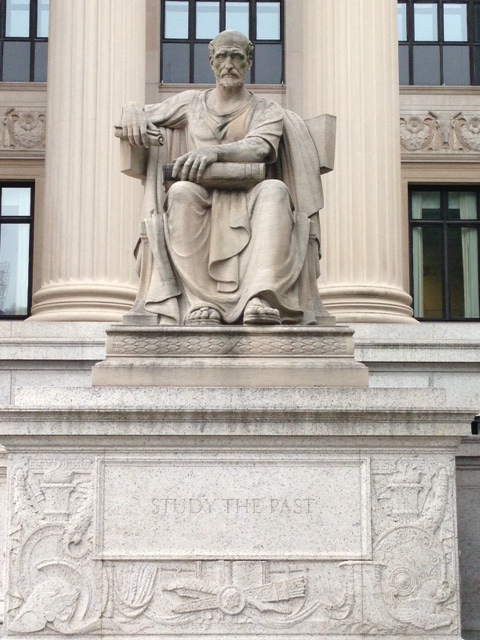
As I prepare for tomorrow I am reminded of the phrase on the statue in front of the National Archives: "Study the Past".

I am looking forward to doing just that!  Studying the past, and then teaching future generations.

Sunday, June 2, 2013

Preparing for Journey

As I take time to prepare for my incredible journey I am dealing with the recent loss of my Safta (grandmother).
Last week, at the age of 89 my Safta passed away in Israel, where she resettling in 1957 after the war.

Like many grandparents my Safta was an incredible source of strength and wisdom for our family.  
In preparing for this trip I remind myself that

my
Safta's immediate family are just
a few of over six million that lost their lives in the camps of Europe and how others, even having survived, were never whole again.  My grandmother and her sister were the only survivors of their large family.
This trip will not be easy or pleasant.  We will travel to the places where
my
Safta and countless others lived, loved, and lost their lives.  We will walk their streets, dwell in their buildings, and see the chambers that lead to their deaths.
I believe that to fully understand something one needs to be educated about the topic.  For me, part of this education involves the hands-on experience of visiting the sites where these atrocities occurred and learning more about the lapse in social conscious that made these events possible in history. 
With that in mind I look forward to our coming educational journey and resolve to share

my
experience with others so that future
generations
can be gifted with knowledge and understanding.
I take this trip in honor of my safta.  For me, her memory will always be for a blessing.